

Most aviation safety writing is about what happens in the air. This piece is about what happens at walking pace, on taxiways and ramps, between pushback and the runway.
24 NTSB investigations, published between 2008 and 2026, are collisions that happened while pilots were taxiing or manoeuvring their own aircraft. They cover airlines, regional carriers, cargo and medevac operators, a foreign carrier and a business jet. Nobody was killed. Several aircraft were substantially damaged, and a handful of people on the ground and in the cabin were hurt.
Reading them in sequence, the striking thing isn’t any single event. It’s that the same collision keeps happening. So, the question is, why.
Why #1: Why is it always the tail?
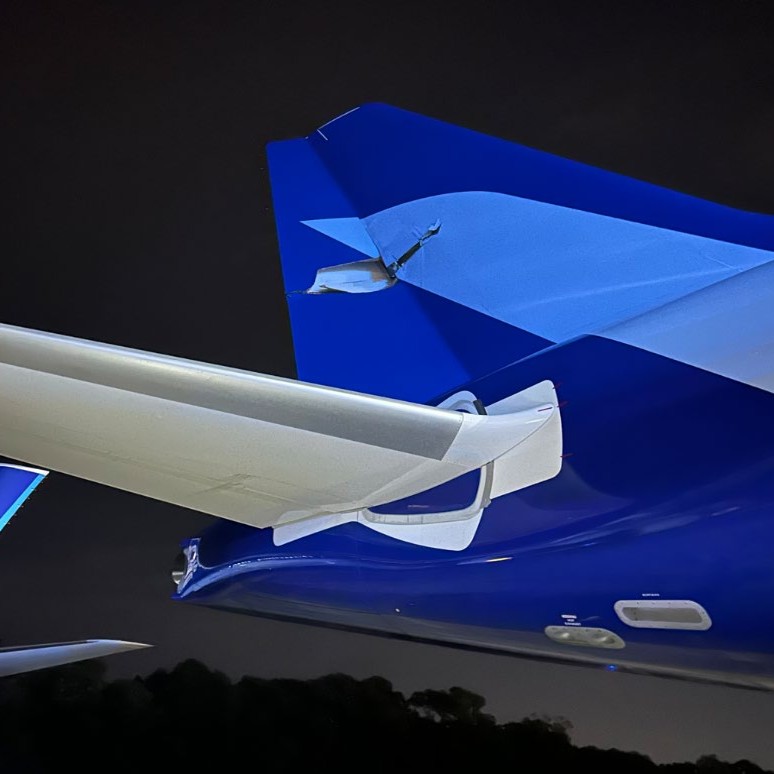
Twelve of the 24 collisions were one aircraft’s wingtip or winglet striking another aircraft. In 11 of those 12, the part that was hit was the other aircraft’s tail: the horizontal stabilizer, the elevator or the rudder. The past year’s Air Safety Network worldwide reports show the same thing: of the 16 aircraft-to-aircraft strikes where the report says what was hit, 10 hit the tail.
That isn’t bad luck. It’s geometry. The tail is the part of a stopped aircraft that sticks out furthest behind it. Its own crew can’t see it. And for a crew taxiing past, judging whether a wingtip 60 or 100 feet away will clear a tail that sits behind them as they turn is close to impossible from the flight deck. Swept wings make it worse: during a turn, the wingtip trails well behind the pilots’ eye line and swings outward.
CASE STUDY | ATLANTA, DECEMBER 2011
“Snug up on the 757”
A Boeing 737 was told by ground control to “snug up” behind a Boeing 757 in the departure queue at night. About 15 minutes later, the 737 turned right onto an adjacent taxiway to leave the line.
The captain looked out of his side window, judged that he had enough clearance, and continued the turn. The 737’s winglet struck the 757’s horizontal stabilizer. The NTSB’s findings pointed to the captain’s perception of the gap.
What it tells us: A side-window glance during a turn is the least reliable way to judge a wingtip gap, and the instruction that set up the event encouraged the aircraft to close the spacing in the first place.
Why #2: Why didn’t the crew see it coming?
In many of these reports, the crew did sense something. What they didn’t have was a reliable way to measure it.
At Salt Lake City in 2009, a turboprop crew moved four feet off the centreline to give a parked fuel truck more room, and the first officer was specifically assigned to watch the wingtip. Sun glare made the gap impossible to judge and the wingtip hit the truck. At Charleston in 2025, a Boeing 787 crew thought a parked aircraft looked “closer than normal”, moved over “just to be safe”, and still struck its rudder. Moving over is a guess about the size of the gap. When you can’t see the gap clearly, a guess is all it is.
CASE STUDY | ATLANTA, AUGUST 2024
“A shudder, like an uneven taxi surface”
An Airbus A350 was ahead of an Airbus A330 on the way to the runway. The A350 crew told the tower they needed extra time at the end of the taxiway to recalculate take-off data after a runway change. The A330 crew said they could go immediately and were cleared to depart via a 90-degree right turn onto an adjacent taxiway.
During the turn the A350 slowed. The A330 captain looked back at his left wingtip and saw that it was already beyond the A350’s tail, so he believed he was clear. He wasn’t. His winglet had already struck the A350’s right horizontal stabilizer.
Neither crew realised. The A330 crew felt a shudder they took for an uneven taxiway surface; the A350 crew heard an abnormal noise. Both aircraft took off, one for São Paulo and one for London. The A350’s substantial damage was found after landing. The NTSB cause was the A330 crew’s incorrect evaluation of the clearance.
What it tells us: Looking back after the wingtip has passed tells you where it is now, not what it touched on the way. And a collision at taxi speed can feel like nothing at all from the flight deck.
Why #3: Why was the other aircraft in the way?
In most of the aircraft-to-aircraft strikes, the aircraft that was hit wasn’t where the passing crew expected it to be. A Dash 8 at Washington Dulles was waiting short of its gate because no marshallers had arrived. An Embraer 145 at JFK had stopped past its hold point at a confusing Y-shaped intersection. Aircraft on deice pads at Detroit and Boston were stopped short of their marks. Each one left its tail sticking into a space that the next crew believed was clear.
The common thread is that nobody told the crew taxiing past. The stopped aircraft didn’t report that it was out of position, and controllers and ramp staff didn’t pass it on.
CASE STUDY | CHARLESTON, JULY 2025
Parked over the line
An Airbus A220 diverted to Charleston at night and was marshalled onto an overnight parking ramp. The ground handling manager chose a spot designated for smaller aircraft, to leave room for equipment and the fuel truck. The A220 ended up with its main gear past the ramp’s clearance line and its tail protruding into the taxiway. Its crew didn’t know the ramp layout, and the airport’s operations team didn’t know a large Boeing would be taxiing past.
Minutes later, ground staff called the A220 crew to say they needed to move the aircraft to let a Boeing through. Before they could, a Boeing 787 taxied by in the dark. Its crew thought the A220 looked closer than normal, moved over to the right, and the first officer pressed his face to the windshield to watch the wingtip. The 787’s left wingtip struck the A220’s rudder. Both aircraft were substantially damaged, and two A220 passengers were hurt as they returned to their seats.
What it tells us: The hazard was known, and someone was already trying to fix it, but the one crew that needed to know was never told.
Why #4: Why did crews keep going?
Stopping costs something: a delay, a call to ground control, an awkward moment with the aircraft behind you. Continuing feels fine right up until it isn’t. When a controller asks “do you have enough clearance?”, the natural answer is yes, and at Salt Lake City in 2024 that is exactly what a crew said before their winglet hit the tail ahead.
The most uncomfortable pattern in the reports is about who sees the hazard. Repeatedly, it was the first officer. At Nashville in 2013, a first officer saw a light pole and said nothing, because he assumed the captain, who was turning away from it, had seen it too. He hadn’t, and the wing hit the pole. At Atlanta in 2019, a first officer’s “stop, stop, stop” limited a collision with a tug that failed to give way.
CASE STUDY | NEW YORK JFK, OCTOBER 2014
“Too close… very, very close”
An Airbus A340 was taxiing at dusk past a regional jet that had stopped beyond its hold point at a Y-shaped intersection. The A340’s first officer told the captain the other aircraft was too close, repeated it, and told him to stop.
The captain replied that it looked fine from his side and kept going. A relief pilot was asked to look as well. The A340’s wing struck the regional jet’s tail.
What it tells us: The warning existed, was spoken aloud, and was overruled. A stop call from any crew member should work like a go-around call: you act first and discuss afterwards.
“…too close… too close… very, very close.”
First officer, Airbus A340, JFK 2014, as reported by the NTSB
Why #5: Why does it keep happening?
This is the question that matters most, and the reports answer it plainly. The same collisions recur because what one organisation learns rarely reaches the next one.
Three pairs of events in the set are near-copies of each other, at different airports, 8 to 13 years apart. An aircraft short of its spot on a deice pad was struck by a passing winglet at Detroit in 2016 and again at Boston in 2024. A widebody clipped the rudder of an aircraft stopped short of its gate at Washington Dulles in 2012, and again at Charleston in 2025. And the Atlanta 2011 turn behind a queued aircraft happened twice more in 2024, just 35 days apart.
CASE STUDY | SALT LAKE CITY, JULY 2024
Stopped to recompute, struck from behind
Aircraft were queued at night on a taxiway for departure when the controller passed on a new wind that exceeded the tailwind limit for an Airbus A320 in the line. Its crew set the parking brake to recalculate their take-off performance.
The Boeing 737 behind it got new numbers from its company that allowed an intersection departure. The crew requested it, and when ground control asked whether they had enough room to manoeuvre behind the A320, they said yes. The A320 crew saw the 737 start to turn, realised it was too close, and released their brakes to pull forward a few feet. It wasn’t enough. The 737’s winglet struck the A320’s horizontal stabilizer and elevator.
Thirty-five days later, the Atlanta collision in Why #2 followed the same sequence: an aircraft stops to recompute after a change, the one behind sees a chance to go first, and the turn behind the stopped aircraft is misjudged.
What it tells us: This exact scenario had happened at Atlanta in 2011. The investigation was published, but the lesson clearly didn’t reach the crews, controllers or training programmes involved in 2024.
What would break the chain
None of this needs new technology. It needs a handful of habits, applied consistently by the people moving aircraft:
1. Brief the taxi before you move. Make a threat and error management (TEM) pre-taxi briefing part of every move. Cover the route and hotspots, any stopped or out-of-position aircraft, tail and wingtip clearance, de-icing, darkness or contamination, and workload such as reprogramming, and agree where you’ll stop and who calls it.
2. If you can’t judge the gap, stop. Moving over a few feet is still a guess. Hold position and get a wing walker, a marshaller, or have the obstacle moved.
3. Anyone’s “stop” means stop. Treat it like a go-around call. And if you see a hazard, say so, even if you think the other pilot has seen it too.
4. If you’re stopped out of position, say so. Tell ground control or the ramp. Your tail is invisible to you and obvious to nobody else until it’s too late.
5. Confirm things directly, not by inference. A green docking light, a thumbs-up or an instrument reading is not the same as a person confirming the area is clear.
6. Following guidance doesn’t end your lookout. Marshallers, follow-me drivers and ramp towers set up several of these collisions. Keep scanning the wingtips and the tail swing.
7. Felt a bump? Stop and get it checked. A shudder or an odd noise during taxi may be a collision. Find out before you take off, not after you land. The same goes for a jolt at the gate: more than four in ten of last year’s ground-collision reports were aircraft hit while they stood still.
Pilots aren’t the only ones who can break the chain. Controllers can stop asking crews whether they have room and start warning them about aircraft that are stopped out of position. Ground handlers can verify that each aircraft is on its mark with its tail clear before the next one moves. Airports can keep charts in step with the paint and light the hotspots. And operators can put these case studies into recurrent training, and share their own ground events with each other, so the next version of the Atlanta turn doesn’t happen again.
Photo: NTSB docket DCA25LA267 (operator photo).
Sources and notes
All facts and quotations are taken from NTSB Aviation Investigation Reports. Case studies are condensed; the full reports and dockets are available from the NTSB using the numbers below.
Case studies: DCA12CA021 (Atlanta 2011); DCA24LA295 (Atlanta 2024); DCA25LA267 (Charleston 2025); DCA15FA004 (JFK 2014); DCA24LA245 (Salt Lake City 2024). Other events mentioned: WPR09IA123 (Salt Lake City 2009), DCA12CA122 (Washington Dulles 2012), DCA13CA106 (Nashville 2013), DCA16CA094 (Detroit 2016), DCA19CA146 (Atlanta 2019), DCA24LA092 (Boston 2024).
The NTSB does not assign fault or blame, and its reports cannot be used as evidence in civil actions for damages (49 U.S.C. 1154(b)). This article uses them for prevention only, and deliberately describes events by airport and aircraft type rather than by airline.