

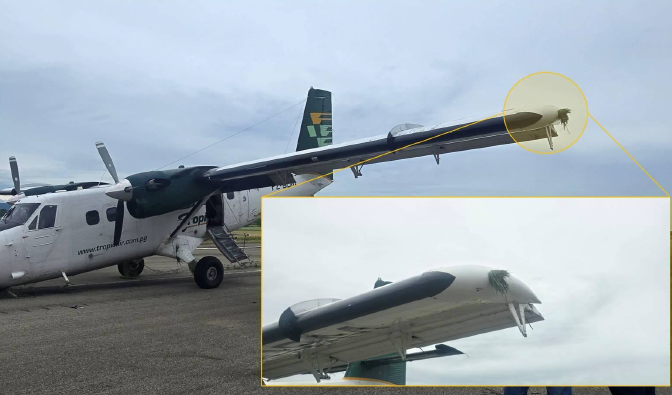
On 22 January 2026, a Tropicair de Havilland Canada DHC-6-300 Twin Otter (P2-BBM) lost directional control on its take-off roll from runway 09 at Tapini Airstrip, Papua New Guinea. It left the runway, went through the perimeter fence and became airborne. The nose wheel and lower fork separated after lift-off. The crew flew on to Port Moresby and landed on runway 32L without the nose wheel. None of the 21 people on board was injured.
The 915 m grassed red clay strip slopes 4.5% down to the east. Before leaving Port Moresby, the crew were told the weather at Tapini was fine. They received no runway surface information. Only on final for runway 27, past their committed point, did they see that the grass had been freshly cut and the surface was wet and muddy.
At 09:33, as the aircraft aligned with runway heading, it began to slide forward. The aircraft yawed right, was turned back, then overshot to the left. The pilot in command used rudder, asymmetric power and full nose wheel steering tiller. Directional control was lost and the aircraft left the left side of the strip into long grass. About 16 m of barbed wire wrapped around the right main gear.
The crew declared a PAN PAN and held for about 30 minutes while emergency arrangements were put in place. They touched down on runway 32L on the main gear. As the nose lowered, the remaining strut contacted the runway and the aircraft slid about 87 m before stopping.
Findings
The ATSB's metallurgical examination found predominantly ductile overstress, with no fatigue cracking or pre-existing defects. The AIC concluded that significant steering inputs while skidding on a low-friction surface began overload fractures in the nose wheel fork. Fence wire wrapped around the fork was then likely overrun by the right main wheel, adding a sudden tug.
Contributing factors were the wet, muddy surface after overnight rain, poor drainage, the 4.5% downhill gradient and lateral slope of runway 09, vegetation and fencing next to the runway, and limited runway condition information before departure.
Safety Actions
Tropicair has:
1. Completed a risk assessment of operations into Tapini.
2. Trained the Tapini agent in weather observation and runway condition reporting.
3. Installed a rain gauge at Tapini.
4. Updated its Route Guide and procedures for wet and sloping remote airstrips.
5. Cleared the airstrip drainage system and runway edge vegetation.
Photo from the official report