

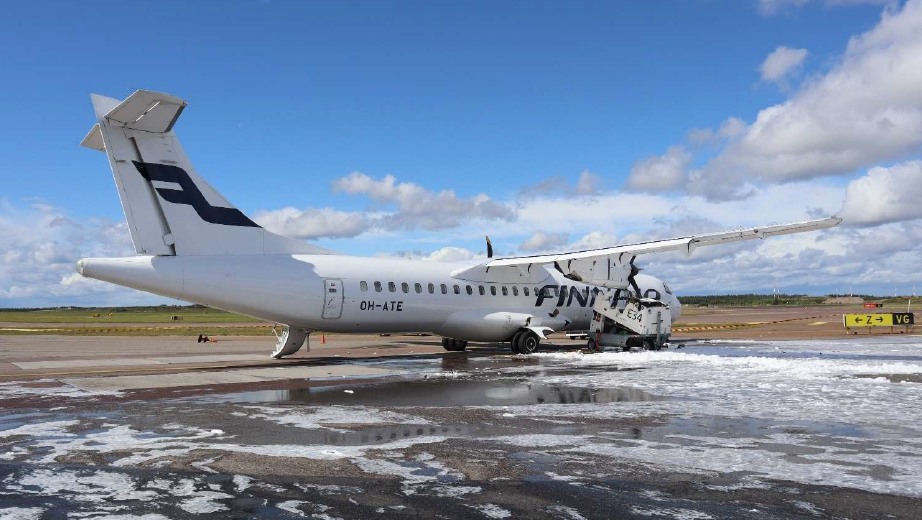
On 16 August 2025 an ATR 72 rolled forward during engine start at Helsinki-Vantaan and struck a ground power unit.
Finnair flight AY1175 to Gdańsk, operated by Norra, was due to leave stand 131 at 10:25 with 64 passengers and four crew. The ATR 72-500, OH-ATE, had been in maintenance overnight. An aircraft swap delayed its arrival, and the crew were already waiting on the stand when Airpro's tug driver towed it in.
Usually the aircraft is secured before the crew arrive. That morning the crew boarded before the driver, towing alone, had finished his tasks, which included setting the parking brake. The driver formed the impression that the captain was in a hurry, felt he was in the way in the confined cockpit, and left. The parking brake was not set.
The brake featured on two of Norra's checklists, and neither pilot noticed it was off. The dispatcher had no voice contact with the cockpit, and a parking-brake hand signal in Airpro's manual was not used in practice.
At 10:38 the crew received start clearance. As the right engine started, the aircraft moved forward about nine metres over roughly 15 seconds while the pilots carried out their checklist. The dispatcher ran around the nose to safety, and the right propeller struck the ground power unit.
The engine was damaged and the propeller destroyed. Fragments struck the fuselage, some penetrating the pressure hull. Inner window frames came loose, and some fell onto passengers. Debris spread across several taxiways. The largest blade section, over a metre long, landed about 30 metres away, beside the dispatcher.
The captain set the parking brake, shut down the engines and pulled the fire handle. He reported the event to ATC at 10:43 without declaring an emergency or urgency and handled the aftermath without involving the first officer. The alarm was raised at 10:48. Rescue units arrived at 10:51, but there was no common radio frequency between the aircraft and the rescue service. Some units initially parked downwind in carbon-fibre dust, and taxiway closures were delayed. Passengers were on buses by 11:14. The area was foamed at 11:20, after they had left.
OTKES found that the handover of control between ground handler and crew was unclear, and that practice had drifted from both companies' manuals. Cockpit-procedure occurrences made up about 3% of Norra's 2025 reports, compared with around half in international data. A Finnair ATR had struck a ground power unit at Helsinki for the same reason in 2002.
OTKES recommended that Norra develop its cockpit procedures, crew cooperation and deviation reporting. It also recommended that Norra and Airpro jointly clarify their manuals where their operations meet, and that Finavia and Fintraffic ensure direct radio contact between aircraft and rescue services is used when needed.
Since the event, Airpro and Norra have introduced a parking-brake hand signal before engine start, and the nosewheel chock may now remain in place during dispatch. Airpro requires a checklist for every single-person tow, and Norra has added the event to recurrent training.
Photo Source: Safety Investigation Authority, Finland (SIAF), Onnettomuustutkintakeskus (OTKES) investigation report L2025-02, published 1 October 2026.