

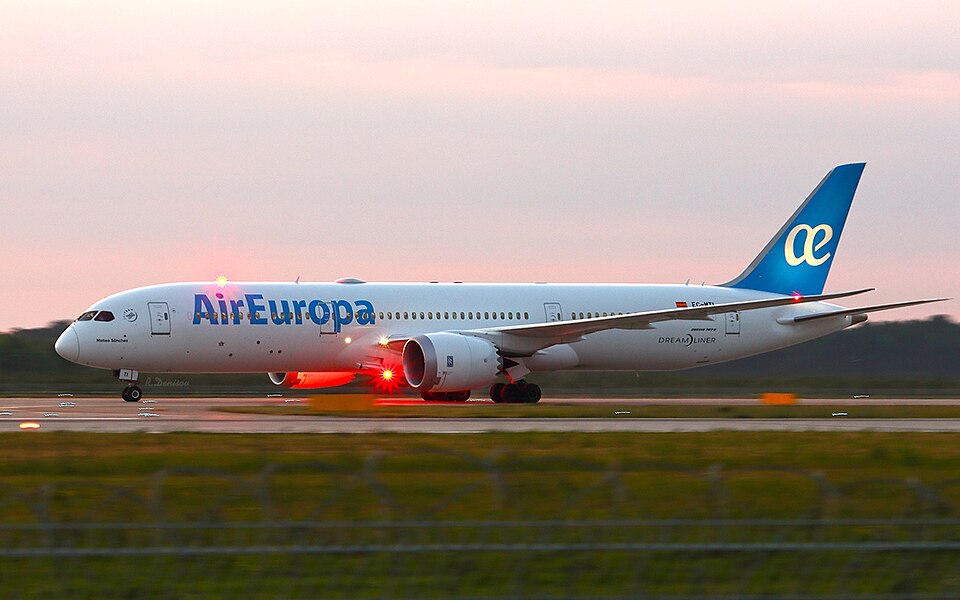
On 1 July 2024, a Boeing 787-9 (registration EC-MTI) operated by Air Europa suffered an in-flight accident while cruising at FL360 over the South Atlantic, roughly 430 NM from Natal, Brazil. The aircraft was flying from Madrid–Barajas to Carrasco International Airport in Montevideo, Uruguay, carrying 11 crew and 325 passengers.
After deviating around a storm cell about five hours into the flight, the captain began a controlled rest period in the flight deck (permitted under EU regulations when workload is low), while one first officer flew as Pilot Flying and the other rested in the crew bunk. At 04:25 UTC, the resting captain turned in his seat and inadvertently struck the control column with his leg, applying about 100 lb (45 kg) of force — well above the 64 lb (29 kg) needed to disconnect the autopilot. This caused the autopilot to disengage and the aircraft to pitch down suddenly, descending from 36,000 ft to about 35,272 ft, reaching vertical accelerations between -1.5g and +1.9g. The first officer at the controls almost immediately took over, climbed back to the selected altitude, and re-engaged the autopilot.
The abrupt movement threw several unbelted occupants against cabin fixtures, injuring passengers and one cabin crew member. Ceiling panels in the passenger cabin were damaged and oxygen masks deployed. Due to the severity of injuries — including a passenger suspected of having a heart attack — the flight diverted to Grande Natal International Airport (SBSG) in Brazil rather than continuing or landing at the closer Salvador de Bahía. On arrival, disembarkation was hampered because the airport lacked stairs suited to the 787’s door height, delaying evacuation of the injured; the crew did not leave the aircraft until about five hours after landing. In total, 8 passengers were seriously injured (fractures/trauma) and one crew member lightly injured; 327 people were uninjured.
Flight data recorder analysis confirmed the autopilot disconnected at 04:25:50 UTC due to the excessive force on the left control column, consistent with the captain’s account. Crew duty times were within legal limits, and fatigue was not reported as a contributing factor. Seatbelts and seats were found to have no mechanical faults; investigators noted that occupants wearing seatbelts were not injured, while those without were.
The accident’s cause was determined to be an inadvertent activation of the flight controls during the controlled rest period, causing abrupt aircraft movements that injured several occupants. No aircraft technical deficiencies contributed.
No formal safety recommendations were issued. However, Air Europa voluntarily implemented several preventive measures, including keeping cockpit seats lowered during meals, so that meal trays do not interfere with the flight controls, greater autopilot use in turbulence and extended seatbelt-sign illumination during controlled rest periods. The Activation and deactivation the seatbelt sign according to circumstances (avoiding continuous illumination, which causes passengers to stop paying attention to it), and make verbal announcements reminding passengers to keep their seatbelts fastened even when the sign is off and visible over blankets. They also removed SBSG as an approved ETOPS alternate airport due to its ground-handling limitations.
Photo source: Guahoo, CC BY-SA 4.0, via Wikimedia Commons