

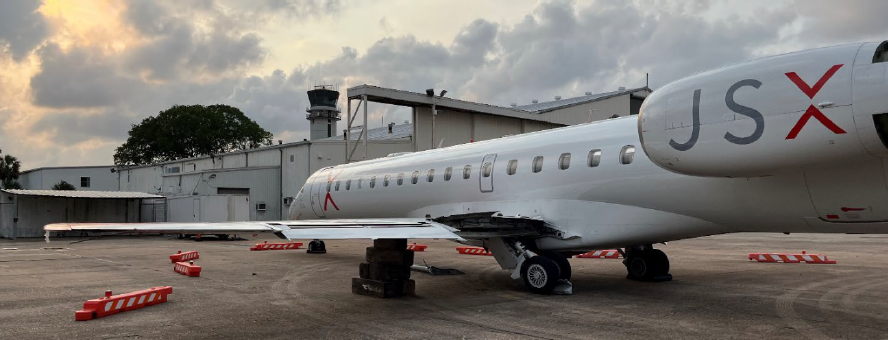
A JSX Air (Delux Public Charter) Embraer EMB-145LR, N942JX, was on a Part 135 non-scheduled flight from Dallas Love Field to Houston Hobby with 3 crew and 21 passengers. It landed hard on runway 4 and the left main landing gear separated. The aircraft was substantially damaged: the left wing's spar III was fractured and the gear strut punched through the upper wing skin. The first officer had minor injuries and nobody else was hurt.
What Happened
The wind was 130° at 16 kt gusting 24, which is effectively a direct crosswind on runway 4. That was within the aircraft's 30 kt recommended maximum. The captain was pilot flying and voiced concern about the crosswind. The FO said it was "not that bad" and offered to request another runway, but the captain declined. Runway 13 suited the wind better, but the crew said Hobby routinely insists on runway 4 for arrivals.
The captain disconnected the autopilot at about 1,300 ft agl. Soon afterwards she began trimming nose down while pulling back on the column to hold attitude. The nose-down trim continued all the way down. At touchdown the stabiliser was near full nose-down (about -4°), and the elevator was around 17° nose-up without producing any pitch increase. As a result the aircraft never flared. The recorded vertical load was about 3.9g, against a gear design limit of about 2.19g. The gear separated as designed to protect the wing structure and fuel tank.
The captain told investigators that she called for the go-around but it was too late. Although the captain did not recall initiating the go-around, FDR data showed an increase in engine power and aft control column position, however, AND pitch trim inputs continued.
Key Findings
The flight data showed the captain habitually used trim during manual approaches and the flare. On her previous landing she had trimmed nose-up in the final 10 seconds. On the accident flight she trimmed nose-down instead, the opposite of her own technique. JSX and CAE said trimming after autopilot disconnect, especially below 500 ft, was not trained and was actively discouraged. However, there was no published procedure addressing it. JSX's SOPs only said the aircraft should be properly trimmed on approach to maximise elevator authority.
Post-accident testing found the pitch trim system fully serviceable. The captain had right-eye amblyopia, covered by an FAA waiver. The NTSB found no evidence that it contributed.
Check rides used a steady 10 kt crosswind, with 15 kt optional.
Probable Cause
The captain's unintentional use of nose-down pitch trim on final approach limited elevator authority. This led to a hard landing that collapsed the left main gear.
Inconsistencies in the Report
• It gives the landing weight as 1,729 kg, which can't be right for an EMB-145.
• It gives trim at 250 ft agl as both "2.0° AND" and "2.0° ANU" in different sections.
• The history section says there were no injuries, but elsewhere it records the FO's minor injury.
• The Figure 5 flight data chart is dated 5/4/2024. Accident date 5/3/2024.
Learning Points
• Non-standard personal techniques can persist even when they are discouraged without a formally documented procedure.
• Almost impossible for the pilot monitoring to catch an abnormal trim input.
• Runway allocation norms can discourage crews from asking for a better-aligned runway.
Photo source: NTSB report