

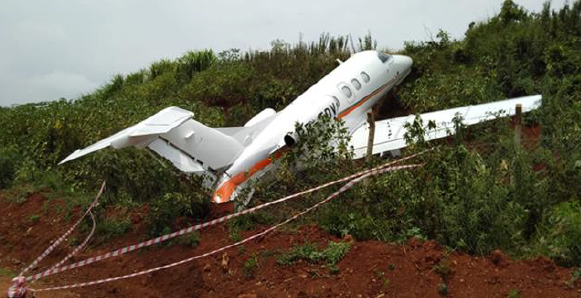
An Embraer EMB-500 Phenom 100, PR-TDV, landed on a 1,200m runway in wet conditions with a slight tailwind. Although the aircraft touched down on the runway, it was unable to stop within the available distance. It travelled the full length of the runway, overran the end, crossed rough ground and came to rest beyond the runway boundary, sustaining substantial damage. There were no injuries to the occupants.
The investigation found no evidence of any mechanical failure or brake system defect. Instead, the overrun resulted from a combination of operational factors that reduced braking effectiveness and increased the distance required to stop:
The approach and landing were not flown in a fully standard manner, reducing the available safety margin. Maximum braking was not applied immediately after touchdown as required by the aircraft manufacturer's procedures. During the landing roll, the flaps were retracted. The emergency/parking brake was then applied despite there being no brake system failure. Application of the emergency brake automatically disabled the anti-skid system, causing the wheels to lock and skid on the wet runway, significantly reducing braking performance. Investigators also noted that another person occupied the right-hand seat and could not rule out the possibility that an unqualified individual was flying the aircraft during the approach and landing.
The runway excursion occurred because braking performance was reduced by delayed and inappropriate braking actions on a wet runway. The use of the emergency brake disabled anti-skid protection, causing wheel lock-up and loss of braking efficiency. These factors, combined with a slightly long and fast landing and possible non-standard aircraft handling, resulted in the aircraft being unable to stop within the runway available. No technical defect was found to have contributed to the accident.
Photo source: CENIPA report