

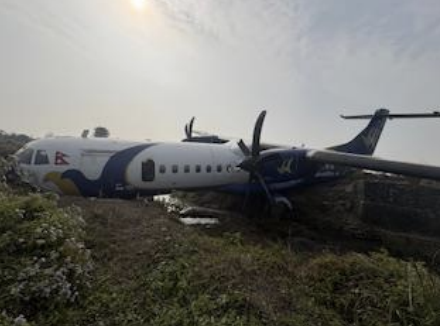
An investigation into a Buddha Air ATR 72-500 runway excursion at Chandragadhi highlights how unstable approaches can rapidly erode safety margins and the value of the go-around.
A Buddha Air ATR 72-500 flying Kathmandu to Chandragadhi at night landed long on the 1,500 m Runway 10, overran, went through the perimeter fence and stopped in a creek about 183 m beyond the runway end. All 56 occupants survived, with 5 minor injuries and no fire.
They were cleared to conduct a VOR RWY 10 approach. At approximately 6 NM from touchdown, the Precision Approach Path Indicator (PAPI) displayed four red indications. The FO then reduced the vertical speed to regain the visual profile. The PAPI later transitioned to three white and one red as reported by the FO.
During short final the PAPI indications transitioned to four white lights, indicating a high approach profile. The aircraft crossed the threshold at about 127 kt against a computed approach speed of 104 kt, then floated and touched down about 1,080 m along the runway, leaving about 420 m.
The FO asked "Can we make it?", the captain said yes, and a go-around was called only seconds before touchdown but never flown. The aircraft left the runway end at about 80 kt.
Human factors
Music was playing in the cockpit was audible during several phases of the flight, there was non-operational chatter below10,000 ft, and checklist discipline was patchy. The captain appears to have napped for about 4 minutes in cruise, with heavy breathing recorded. A steep authority gradient and the captain’s over-confidence in the FO. Crews reported that go-arounds are only practised inthe simulator and that high approaches are normally fixed with a higher descent rate, which the report calls normalisation of deviance.
Post-crash issues
- Emergency lighting: The lights did not come on because the EMER EXIT LT selector was left in DISARM. There was no hardware fault, and the cabin attendant did not use the manual override.
- Evacuation: It was uncontrolled, with no cockpit-to-cabin communication, jammed doors and passengers using torches and phones.
- Right engine: It ran for about 10 minutes. The condition levers were jammed by crushed structure, and the fire-handle circuits were shorted to ground, so the low-pressure fuel valve stalled part-open. The report thinks it finally stopped from fuel starvation, not from the circuit breakers being pulled.
Organisational and aerodrome findings
- Buddha Air FDM: The programme had dropped touchdown location and approach speed as monitored parameters, so it never caught the long flares and unstable approaches that crews described as common. LOSA also failed to pick them up.
- VNCG (non-certified aerodrome): A November 2025 inspection found the PAPI misaligned, runway-end lights obscured by repeated overlays, and no centreline lights. There were many other unresolved deficiencies, including in RFFS, and none had been fixed.
- Crew briefing: Crews were not briefed on the night-lighting risks at VNCG.
- CAAN oversight: The report criticises CAAN's oversight of FDM and of non-certified aerodromes.
Contributing factors
- Weak SOP implementation at Buddha Air.
- FDM failing to detect long flares and delayed touchdowns.
- Runway-end lights not visible.
- No requirement for co-pilot night-landing clearance.
- Degraded CRM, including a non-sterile cockpit.
Key recommendations
- All operators: Run FDM programmes with management-of-change acceptance by CAAN, monitor SOP adherence, report aerodrome deficiencies through their SMS, set a policy on FO night-landing approval, and make sure all FDR parameters are recorded validly.
- Buddha Air: Review its FDM and LOSA programmes and adherence to operational SOPs.
- CAAN: Audit non-certified aerodromes, build FDM oversight capability, and strengthen oversight generally.
- Ministry: Create a permanent accident investigation bureau and separate CAAN's regulator and service-provider roles.
Photo source: Nepal AAIC Report