

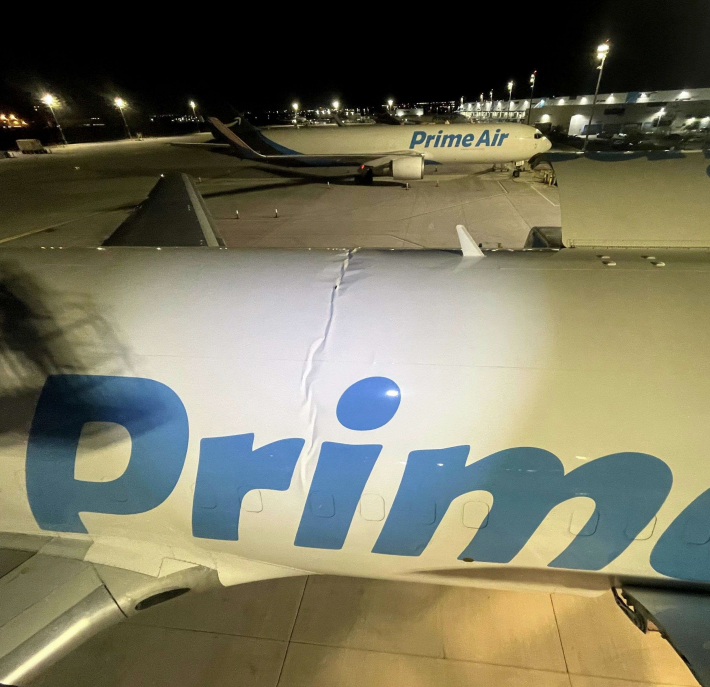
On 15 January 2026, Air Transport International (ATI) cargo flight 4340, a Boeing 767-323 (N443AZ) from Spokane, landed hard on runway 6 at San Bernardino International Airport, California, at 23:13 local time. The nose gear struck the runway forcefully. The crown of the upper fuselage was buckled and fractured, with damage to the underlying stringers and lap and butt joints. Neither of the 2 crew was injured.
The first officer was pilot flying on the ILS to runway 6.
The Landing
The aircraft touched down at about 124 kt, flaps 25, at about 5° nose up, with the control column about 12° aft of neutral. The column then moved to about 20° aft and immediately reversed to about 20° forward over about 1.5 seconds. Pitch rose from about 3° to about 6°, then fell to about 0°. As the nose gear touched down, vertical acceleration spiked to about 1.6 g, then reversed to about 0.1 g.
The first officer recalled a normal touchdown, then the nose tending to pitch up. He applied forward pressure. "At that moment, the controls moved forward abruptly and forcefully", and he momentarily lost his grip. The captain saw what appeared to be an over-rotation. Concerned about a tailstrike, he put his hand out to block the yoke from coming back further. The aircraft then "de-rotated rapidly, landing with a jarring impact."
Neither pilot spoke at the time. The first officer did not realise the captain had restricted the column. The captain, looking at the runway, did not see the first officer's hands slip off the yoke. After landing, they concluded that for a period neither of them was on the controls. The NTSB could not definitively resolve the two accounts, or confirm when or for how long the yoke was released.
The tail would strike at about 8° nose up with the main gear compressed. Boeing's flight crew training manual advises against letting pitch increase or holding the nosewheel off after landing. It also advises against large nose-down column movements, to avoid structural damage.
A Known Hazard
The NTSB found eight similar derotation accidents involving Boeing 757/767 aircraft between 1992 and 2023. In each, large nose-down column inputs after main gear touchdown produced high nose-down pitch rates and high vertical velocities at the nose gear. The resulting loads exceeded the design loads of the forward fuselage crown.
The NTSB's probable cause: the flight crew's improper derotation, which resulted in a hard nose gear touchdown. Contributing was the crew's lack of crew resource management in communicating about pitch control inputs. Also contributing was the crew's lack of situational awareness about control yoke inputs. The captain restricted aft movement and the first officer lost his grip. This led to an uncontrolled nose-down pitch.
Photo source: NTSB Docket (Courtesy of ATI)