

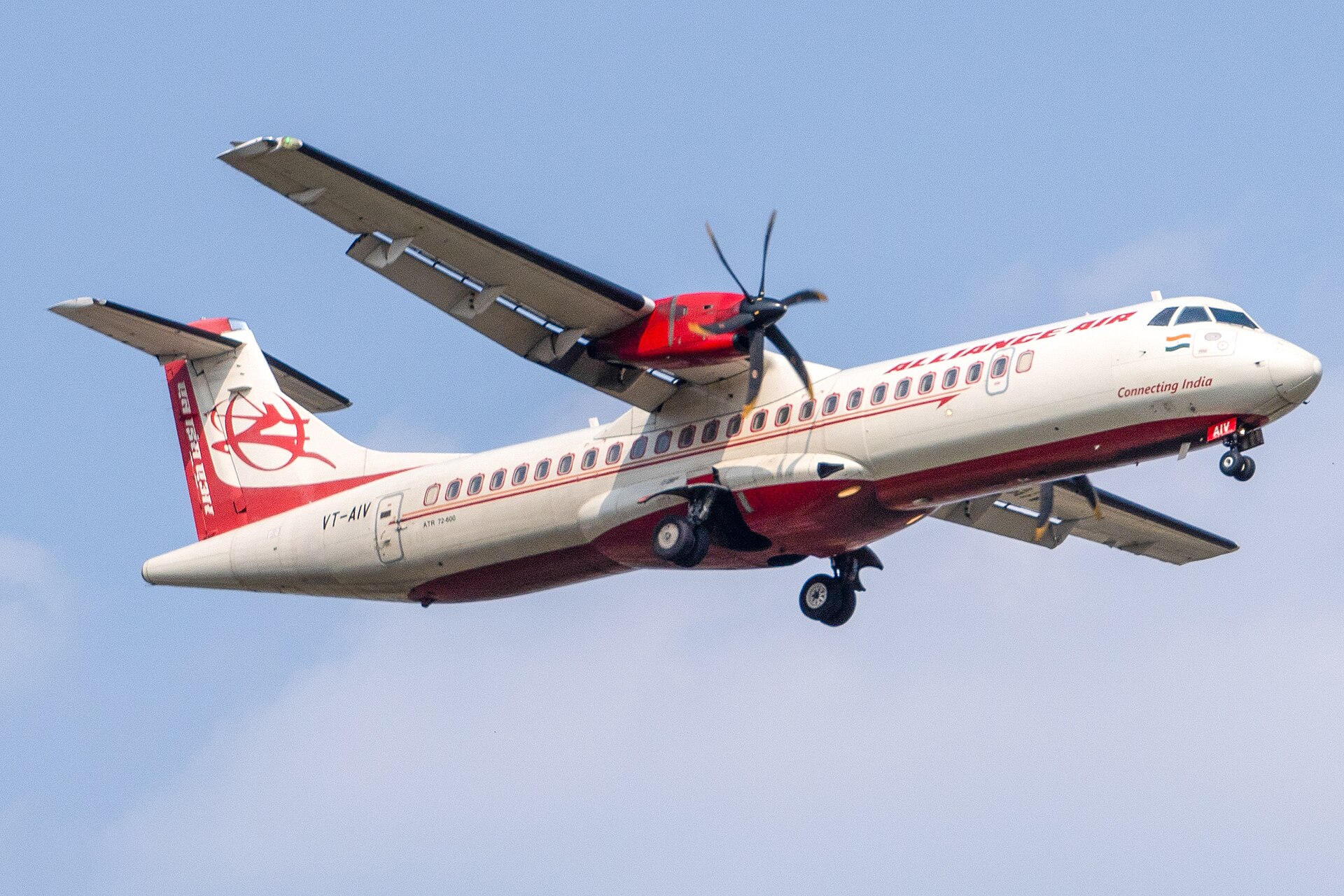
On 8 October 2024, an Alliance Air ATR 72-600 (VT-RKF) touched down short of Runway 14 at Bhubaneswar, India, after a short flight from Rourkela. All 47 people on board were unhurt.
The aircraft hit several approach lights, a concrete electrical pit and unpaved ground before reaching the runway. The damage included a punctured forward belly, cracked stringers and frames, lower aft fuselage panel damage, a holed flap and a torn left main gear door.
Visibility at Bhubaneswar fell from about 4,000 m to 500 m within half an hour, with rain, cumulonimbus cloud and thunderstorms forecast. ATC briefly held the aircraft and then cleared it for the ILS. The approach looked stable down to about 1,000 ft. Then the aircraft flew into heavy rain. Before the approach, the captain had briefed the crew to expect windshear and to go around if it happened.
Flight data shows that between 1,000 and 200 ft the autopilot kept the aircraft on the glideslope and localiser. The airspeed was varying between 110 and 130 kt, and the descent rate was fluctuating, At about 200 ft, the captain pushed forward on the control column with enough force to disconnect the autopilot. Pedal inputs had also driven the rudder trim to about 7° nose-right, and it was never re-centred. The pitch reduced to about 5° nose-down. The descent rate increased towards -1,000 ft/min. Below 250 ft, a 10 kt headwind became a 15 kt tailwind.
By 100 ft the aircraft was two dots below the glideslope. No significant pitch correction occurred until a late flare at about 20 ft. The aircraft landed hard at 1.7 g. The narrative puts the touchdown 30.5 m before the threshold, while the GPS-based analysis says about 100 m. The operator’s manual requires a go-around when the glideslope deviation exceeds one dot below DA.
The AAIB identified the probable cause as continuing an unstable approach in adverse weather. It cited nose-down inputs combined with low-level windshear, late recognition that the approach was unstable, and the decision not to go around. It also pointed to plan-continuation bias and weak crew resource management.
Two further findings.
First, both pilots had a record of earlier flight-data exceedances, including unstable approaches, GPWS cautions and long flares. The investigators found these had been followed up only by email, with no counselling or retraining.
Second, the aircraft’s terrain awareness system gave no glideslope alert. Its filtering placed the deviation outside the alert envelope.
The investigators recommend more simulator training for heavy rain and fast-deteriorating weather, with mandatory remedial sessions for pilots who repeatedly trigger exceedances.
Photo source: Krish Aarush, CC BY-SA 4.0, via Wikimedia Commons
