

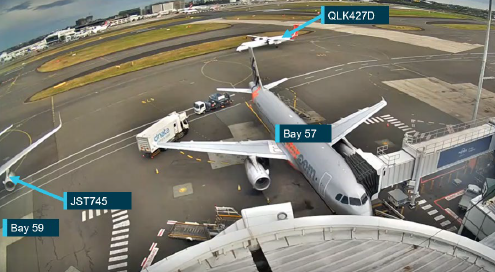
On 25 August 2026, Jetstar flight JST745, an Airbus A320-232 (VH-VFX) bound for Launceston, began pushing back from bay 59 onto taxiway C at Sydney Airport. At the same time QantasLink flight QLK427D, a Bombardier DHC-8-402 (VH-84N) departing for Canberra, was taxiing towards it on the same taxiway. Both aircraft stopped. No one was injured and neither aircraft was damaged.
At 0723:46 local time, the surface movement controller east (SMCE) cleared JST745 to push back after giving way to another Jetstar A320 taxiing behind it. About 30 seconds later, the same controller cleared QLK427D to taxi from bay 17B and hold short of taxiway G. This needed a 180° right turn out of the bay and a 90° left turn to face south on taxiway C.
At 0725:02, JST745 started its pushback. As the DHC-8 captain lined up on taxiway C, they noticed the A320's tail seemed "a long way off the bay". Then they saw the tail moving backwards. The crew had been taxiing at around 10 kt and stopped about 100 m from bay 59. The A320's pushback driver and dispatcher saw the DHC-8, stopped the pushback and told the flight crew.
Both crews queried the controller. The controller had JST745 towed back onto the bay while QLK427D passed behind, then cleared the pushback again.
The Tower
Gates at Terminals 2 and 3 back directly onto taxiway C rather than an apron. The 3 controllers interviewed said pushbacks from these gates were prone to conflicts. Airservices procedures make taxiing separation a joint pilot and controller responsibility.
The SMCE had been a controller for 12 years, 5 of them in Sydney tower. They rated their workload at around 3 on a scale of 1 to 10. Their roster gave a predicted fatigue level of "medium". They said they "felt fine" but had "not had many days off in the past month".
The advanced surface movement guidance and control system (A-SMGCS) gave no alerts for taxiing conflicts on taxiways and aprons. Controllers described bays in that area as a "black spot": aircraft were not always detected there and sometimes appeared only once on the taxiway. Bay 17 was only partially visible to controllers for smaller aircraft such as the DHC-8.
Airservices was required to have a fatigue risk management system (FRMS) approved by the Civil Aviation Safety Authority (CASA) by 1 September 2024. Its FRMS had not yet been approved, and it was operating under a CASA exemption. The current exemption was due to expire on 28 February 2027.
The investigation will review ATC data, CCTV, controller visibility and systems, combined ATC positions, fatigue management and rostering, and similar occurrences. The report is preliminary and contains no findings. The investigation continues.
Photo from ATSB report - Source: Sydney Airport